

SDM Technology Is Transforming Submarine Cable Capacity: What Carriers Need to Know About the Next Generation of LATAM Connectivity
The submarine cables being deployed across Latin America today are not the same infrastructure that connected the region two decades ago. Not just bigger in scale but fundamentally different in architecture. Space Division Multiplexing is the technology driving that change, and if you are a carrier operating in or routing traffic through LATAM, understanding it is directly relevant to your capacity planning, redundancy strategy, and competitive positioning.
SDM Cables Are Delivering Exponentially More Capacity Than Legacy Systems on the Same Physical Routes
Most of the submarine cable infrastructure still serving the Caribbean and Latin America was built on a single fiber-pair design. One transmission path carrying all traffic. When that path has a problem, every carrier and customer riding it feels it immediately. SDM cables are architected differently. They incorporate multiple independent fiber pairs inside a single cable housing, anywhere from four to over two dozen depending on the system. The result is design capacities of 20 to 200+ terabits per second, compared to the sub-terabit performance of most legacy systems still in active service across the region.
SDM is not a brand new technology. It has been the foundation of submarine cable design since around 2010, and it remains the standard architecture for every major cable being deployed today. What has changed dramatically over the past decade is what SDM enables in combination with advances in optical transmission equipment. The real challenge in maximizing submarine cable capacity has always been at the endpoints, specifically in the terminal equipment that lights the cable. Companies like Ciena and Infinera, now part of Nokia, have led the industry in pushing per-fiber-pair capacity records beyond 32 Tbps. That said, capacity is heavily dependent on distance. The longer the route, the lower the achievable capacity per fiber pair. Engineering the right balance between route length and performance is a core part of what separates modern cable design from legacy approaches.
For carriers specifically, the implications go beyond raw capacity numbers. Multiple independent fiber pairs on a single cable create routing flexibility and redundancy architecture that single-pair systems simply cannot replicate. Traffic can be segmented across fiber pairs by customer, service type, or protection class. Maintenance or fault isolation on one pair does not affect traffic on others. Capacity can be lit incrementally as demand justifies the investment, without touching the physical cable plant.
Two Decades of Progress Put in Perspective
The SAm-1 cable, which entered service in 2000, had four fiber pairs carrying 40 Gbps each, with a maximum expandable capacity of 1.92 Tbps. That was considered significant infrastructure at the time. In the twenty years since, the combination of SDM architecture and advances in terminal equipment has driven capacity growth of approximately 150 times on comparable route lengths. Today cables are being built with up to 24 fiber pairs, and the capacity available per pair continues to climb as transmission technology improves.
MANTA, the cable system Gold Data is developing jointly with Liberty Networks and Sparkle, will have up to 16 fiber pairs on its northern segment connecting to Miami and San Blas, Florida. At 22 Tbps per fiber pair, which is what SubCom, our manufacturing partner, can guarantee at the cable level, MANTA’s aggregate design capacity on those segments reaches 352 Tbps. That 22 Tbps per pair figure reflects what the physical cable infrastructure can support today. As the vendors who illuminate the cable continue to develop their terminal equipment, that capacity ceiling will rise over time without requiring changes to the cable itself.
The Stat That Matters
New SDM submarine cables entering service in Latin American corridors are engineered for design capacities exceeding 200 terabits per second, achieved through multiple independent fiber pairs within a single cable system. That is orders of magnitude beyond the sub-terabit design capacity of most legacy systems currently serving the same routes. That capacity headroom changes the wholesale pricing economics, the protection architecture options, and the performance ceiling for every carrier that purchases or routes capacity through these systems.
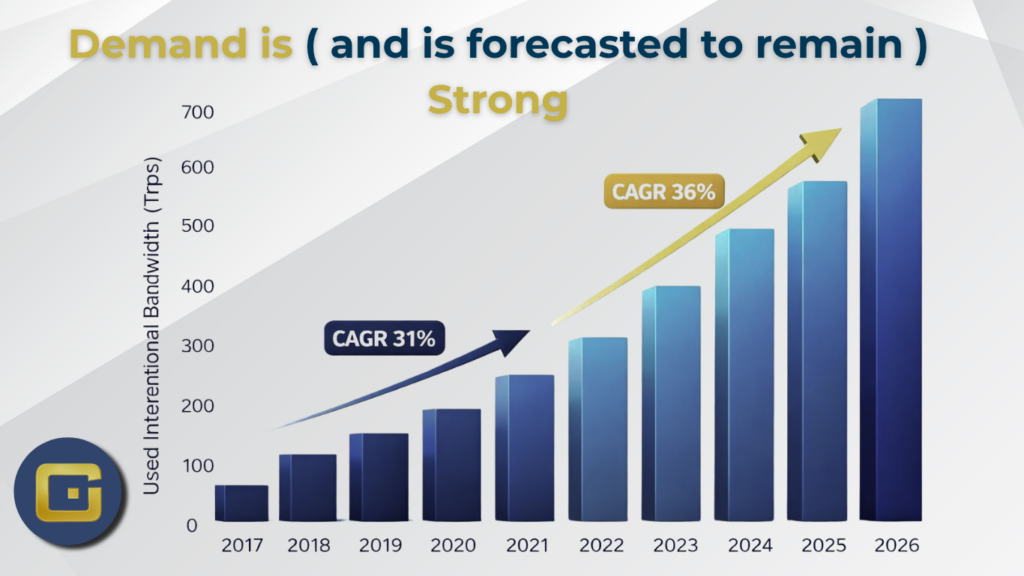
According to TeleGeography data, used international bandwidth in Latin America grew at a 31% CAGR between 2017 and 2021, then accelerated to a 36% CAGR through 2026, reaching an estimated 670+ Tbps. Demand has not just kept pace with the capacity that SDM infrastructure is delivering. In many corridors it is now outpacing it, driven increasingly by AI workloads that are compressing what would have been years of demand growth into months.
Our Perspective at Gold Data
From our position operating infrastructure across the Caribbean and the Gulf of Mexico, SDM is not simply a capacity upgrade. It is a rethinking of what submarine cable infrastructure can deliver for carriers at the architectural level.
When we evaluate cable systems for our own network or in discussions with carrier partners about capacity and routing options, the transition from legacy single-pair designs to SDM changes the risk calculus in a fundamental way. Single-pair cable failures have historically produced complete outages for carriers dependent on that system, with no intra-cable protection path available. SDM’s multiple independent fiber pairs create genuine intra-cable redundancy that redefines how protection architectures are designed and priced.
The MANTA system and the cable infrastructure Gold Data operates in the Caribbean and Gulf of Mexico region are built around exactly these principles: capacity depth, architectural diversity, and the ability to serve different carrier requirements on infrastructure designed for each use case. Wholesale transit, protected wavelength services, dark fiber options, and cloud interconnection pathways can all be delivered from the same SDM cable plant. We do not resell capacity from systems we do not understand or operate. That distinction matters when you are engineering a carrier network.
There is another dimension worth highlighting. The growth in the number of cable systems globally and across LATAM specifically means that carriers now have more route diversity options than at any point in the history of the industry. More cables means more paths between any two points, which means better pricing, better protection architecture, and more resilience for the networks built on top of that infrastructure. This is good for everyone in the ecosystem. Operators who own and manage cables can sell more capacity as technology improves. Carriers who buy capacity benefit from lower unit costs as supply grows and competition increases.
For carriers evaluating LATAM capacity options, the practical takeaway is that connectivity and protection options that were not commercially viable two or three years ago are now entering the market. Dedicated fiber pair capacity for large wholesale agreements. Sub-10ms latency routes on new cable alignments. True carrier diversity on routes where diversity was previously limited by the physical scarcity of cable systems. Understanding how these options map to your traffic engineering requirements and customer commitments is the right conversation to be having now, not after the capacity windows on new systems fill up.
What This Means for Your Network
For carrier network teams planning LATAM capacity additions, SDM-based systems in the region mean the performance and protection ceiling has moved significantly. Realizing that potential requires access to providers who operate SDM capacity directly and have the engineering depth to structure the right capacity agreement for your specific routing and protection requirements.
A useful question for your current LATAM capacity providers: is the infrastructure underpinning your service SDM-based, and what fiber pair options are available? The answer tells you something substantive about capacity headroom, fault isolation architecture, and how that system will perform under traffic growth or protection events. It is a technical question with direct commercial implications.
Gold Data’s LATAM infrastructure includes SDM-ready cable systems engineered for carrier performance and protection requirements. golddata.net
Key Terms Worth Knowing
SDM: Space Division Multiplexing is a submarine cable technology that has been in use since around 2010 and runs multiple independent fiber pairs inside a single cable housing. The result is dramatically higher capacity compared to legacy single fiber-pair designs, along with genuine intra-cable redundancy that older architectures cannot provide. Modern cables can be built with up to 24 fiber pairs, giving operators significant flexibility in how they allocate and sell capacity over the life of the system.
WDM: Wavelength Division Multiplexing is a technology that increases per-fiber capacity by transmitting multiple data streams simultaneously on different wavelengths of light within the same fiber. WDM and SDM work together in modern cables. WDM maximizes what each individual fiber can carry. SDM multiplies the number of independent fibers available.
Design capacity vs. lit capacity. Design capacity is the maximum throughput a cable system can support with fully equipped transmission hardware. Lit capacity is what is actually equipped and operational today. SDM cables are typically lit incrementally as traffic demand grows, which is a significant part of what makes the economics attractive for carriers building out capacity over time.
OADM: Optical Add-Drop Multiplexer is equipment at cable landing stations and branching units that allows specific wavelengths to be added or removed from a transmission path without converting the optical signal to electrical form. OADMs are what make flexible traffic routing possible at the points where submarine cables come ashore and connect to terrestrial networks.
Claudia Tradardi — Head of Marketing & Media Relations, Gold Data . golddata.net